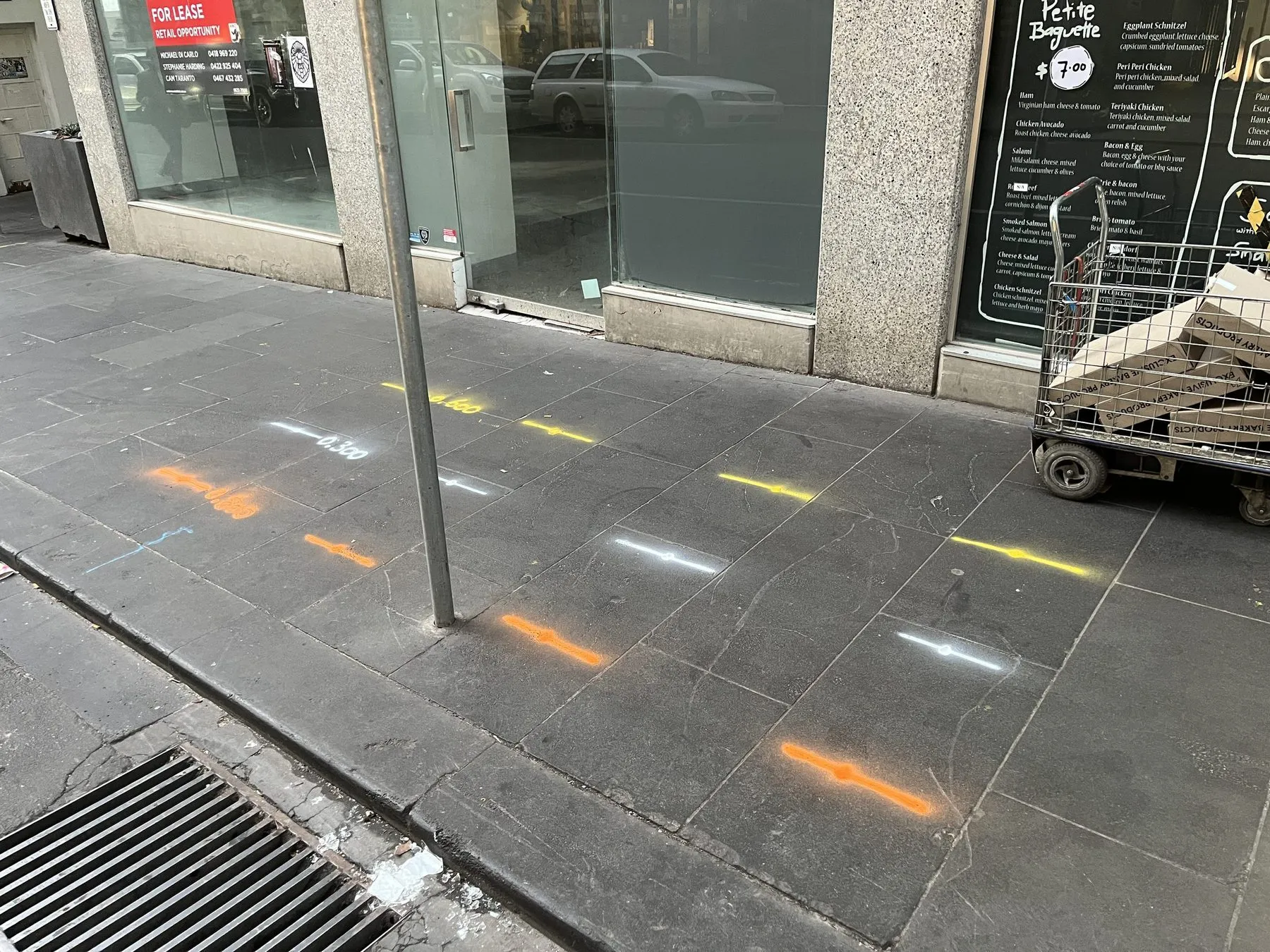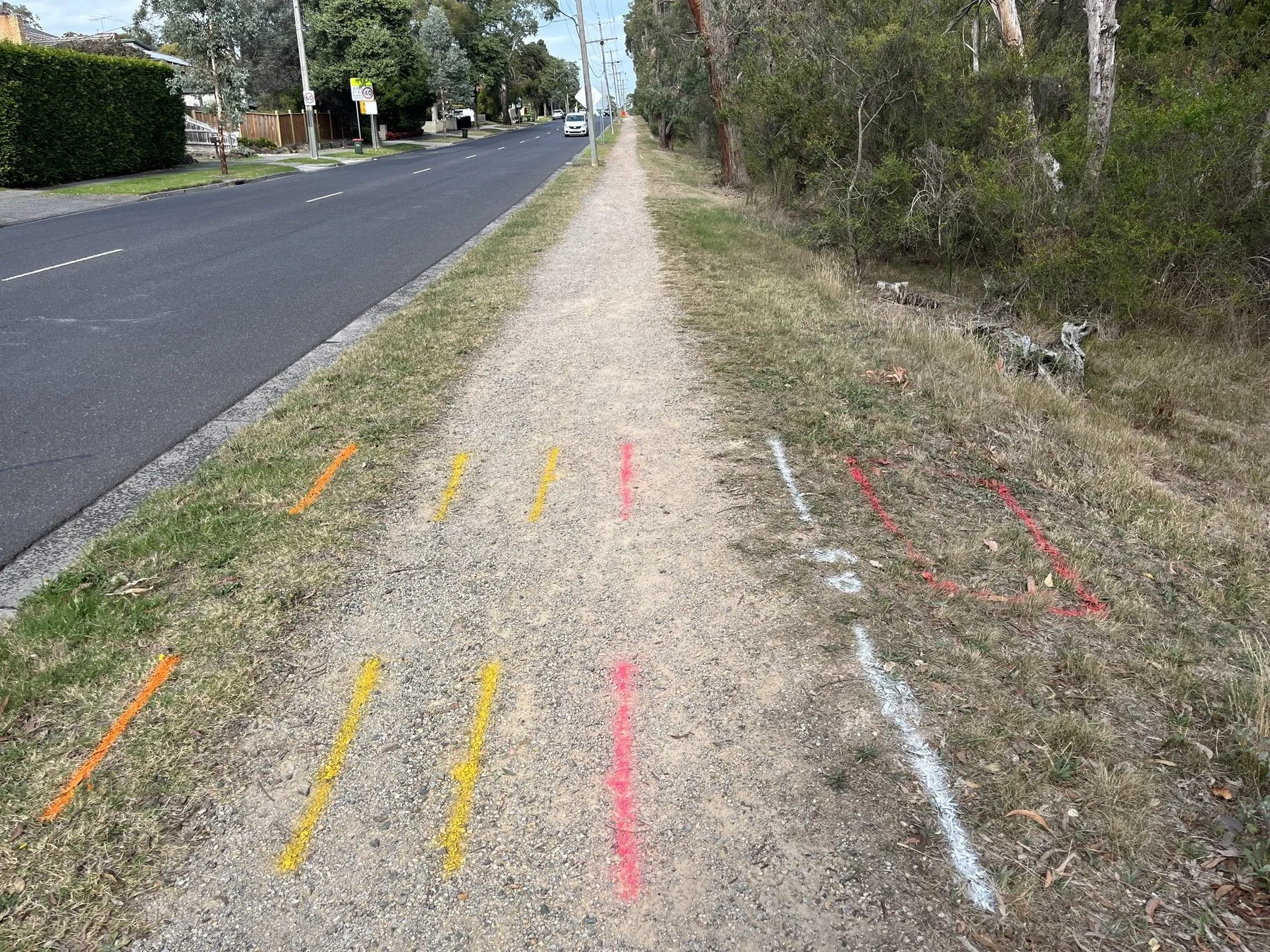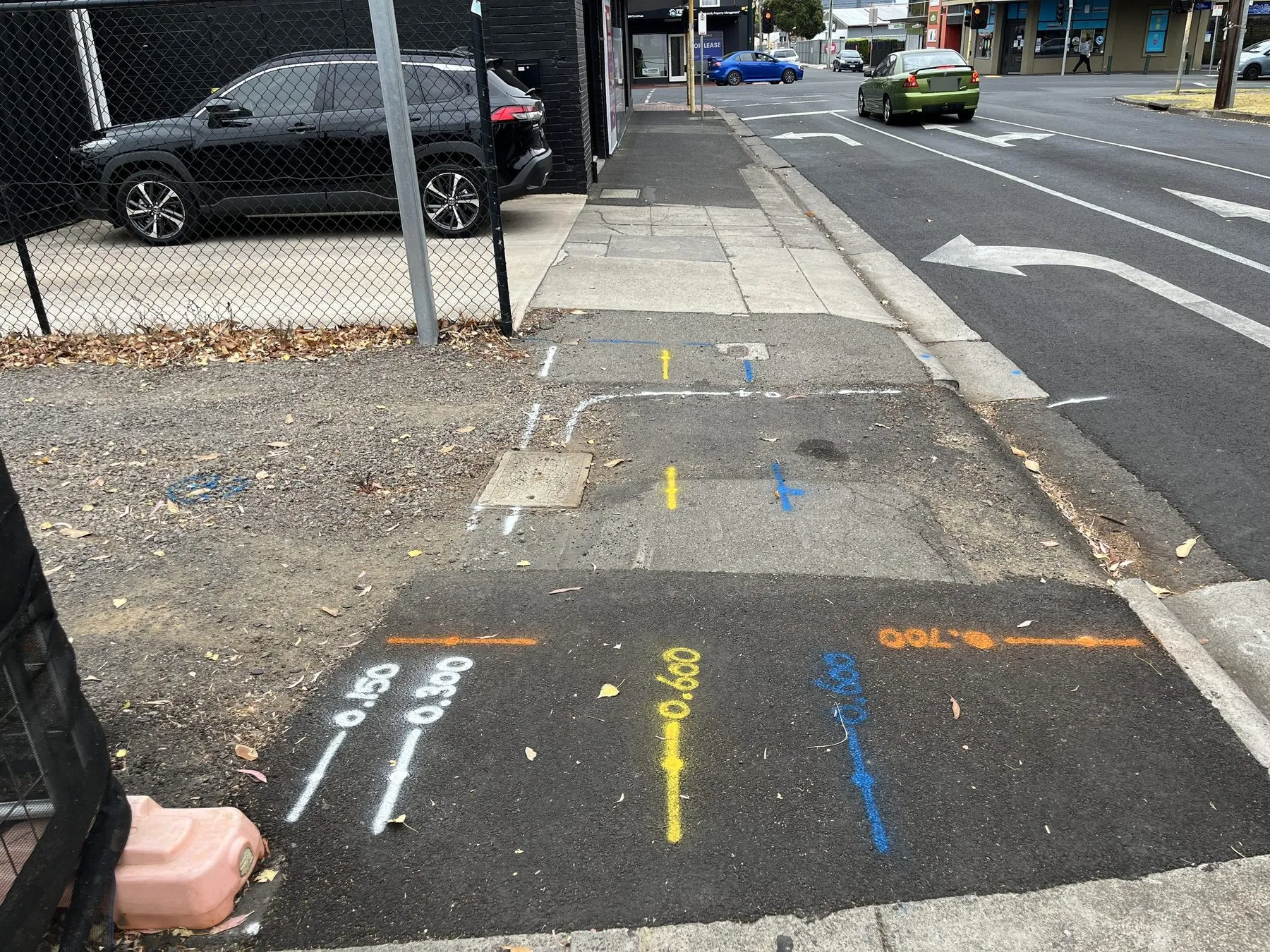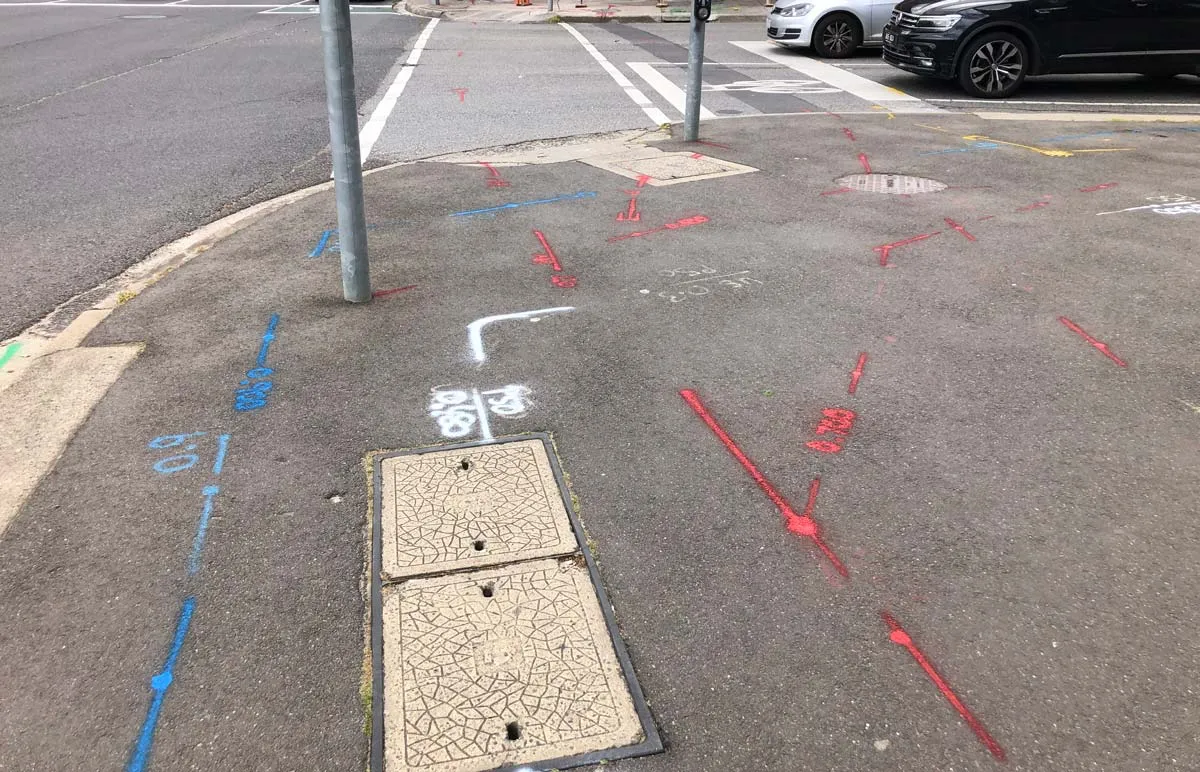

There are three main ways to work out what’s under the ground before you dig: electromagnetic (EM) locating, ground penetrating radar (GPR) and potholing. They’re often talked about as if they’re interchangeable. They’re not.
Each one answers a different question, and each has blind spots. Here’s how they compare, and how to decide what your job needs.
EM locating
An electromagnetic locator traces services that can carry a signal. That means metal pipes, power and telecommunications cables, and plastic pipes laid with a tracer wire.
There are three ways to get a signal onto a service. We can connect the transmitter directly to it at a pit, valve or meter. We can clamp around a cable where it’s exposed. Or we can induce a signal into the ground and pick up whatever carries it. Live power cables also give off their own signal that the receiver can detect.
Once there’s a signal, the receiver follows it, giving the service’s position and an estimated depth. On most sites, EM is the backbone of the locate.
Where it falls short: EM can’t find anything that won’t carry a signal. Plastic water and gas pipes without tracer wire, clay and concrete pipes, and asbestos cement pipes are invisible to it. Busy ground with many services close together can also make signals harder to separate.
GPR
Ground penetrating radar sends pulses into the ground and records what bounces back. Changes in material show up as reflections, so GPR can detect things EM can’t: plastic and non-metallic pipes, footings, old foundations, tanks, voids and wet or disturbed ground.
Where it falls short: GPR’s performance depends heavily on the ground. Moisture and clay absorb the signal and can sharply reduce how deep it sees. Rubble, fill and reinforcing scatter it. It also can’t identify a service on its own. A reflection tells us something is there, but working out what it is relies on BYDA plans, surface features and what EM is telling us.
Potholing
Potholing, also called non-destructive digging (NDD), exposes a service so it can be seen. It’s usually done with a vacuum excavation truck, using water or air to break up the soil and a vacuum to remove it, so the service isn’t damaged.
Once a service is exposed, its exact position, depth, material and size can be confirmed and measured. Under AS 5488, that’s what reaches quality level A.
Where it falls short: potholing only tells you about the spot you dig. It confirms a service at that point, but it doesn’t tell you where the service goes between potholes, or what else is nearby. Without a locate first, you don’t know where to pothole.
We don’t do potholing ourselves. We locate and mark out services, and when exact confirmation is needed, a non-destructive digging contractor exposes them at the points that matter.
Side by side
| EM locating | GPR | Potholing (NDD) | |
|---|---|---|---|
| Finds | Metal pipes, cables, traced plastic pipes | Non-metallic pipes, footings, tanks, voids | Whatever is exposed |
| Gives | Position and estimated depth | Position and estimated depth | Exact position, depth, material and size |
| Coverage | Follows a service across the site | Scans an area | One point per hole |
| Main limits | Can’t detect non-conductive services | Depth limited by wet ground and clay | Only shows what’s dug up |
| Typical AS 5488 level | QL-B | QL-B | QL-A |
When to combine them
Most jobs need more than one method. A few common combinations:
EM and GPR together. This is our standard approach on most sites. EM traces the conductive services. GPR looks for plastic pipes and anything else EM can’t see. Each covers the other’s blind spots.
Locate first, then pothole. On jobs where exact depth matters, such as boring under a service, excavating close to a high-pressure gas main or designing around existing services, the locate tells the NDD crew where to dig, and potholing confirms it.
GPR for non-service features. Crane pads, tank searches and void checks are GPR jobs, often with an EM sweep for services in the same area.
Which one do you need?
Start with what you’re doing and what’s at stake:
- Small trench, fence or footing on a residential site: an EM locate, with GPR if plastic services are likely
- Commercial or civil excavation: EM and GPR, with a detailed plan if the information will be used for design
- Boring, deep excavation or work near critical assets: EM and GPR to find the services, then potholing to confirm position and depth where the work comes close
- Voids, tanks or ground conditions: GPR
If you’re not sure, tell us what you’re doing and we’ll recommend the right mix.
Call us or request a callback.